
Here you’ll find answers to some common questions concerning mental wellbeing
We all have mental health, the same as we all have physical health.

Consider mental health on a spectrum; we all sit there somewhere.
Fortunately there are things that can help us stay in the green area or that can help us cope if we are moving up the spectrum.

Sometimes we feel great, everything seems to be going well, you could say we are in the green area

We all have bad days – this could push us into the yellow area, but generally speaking we are coping

As things get harder and we feel we cannot cope anymore we begin to edge into the orange. Most people have times like this and just like physical health some days are better than others.

Some people move into the red and this is the area where we talk about an individual possibly having a mental illness and they need extra help, this could be from their GP, a psychiatrist or a psychologist depending on the mental illness.
There is evidence to suggest that there are five key things we can do that will help improve and maintain our mental health and wellbeing.
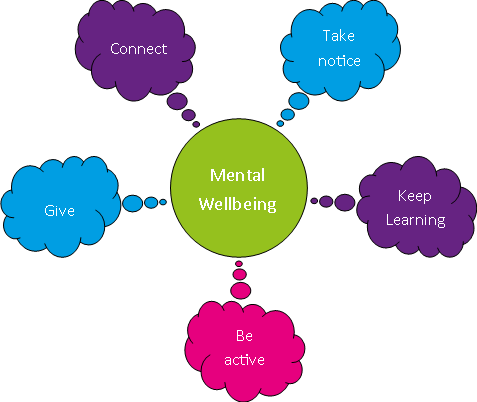
If we try them they may help us feel happier, more positive and get more out of life.

Who can I talk to?
If you haven’t already found the help you’re looking for, you can find additional information and services which are more interactive here.
You can also make a referral to Mental Health Services by completing the online referral form
Feeling close to other people and feeling valued by them is a fundamental human need.

Spend time with those you care about, develop relationships and connect with people.
By connecting with other people you can have feelings of self-worth and belonging. Not only does this make you feel good but it makes those around you feel better too and in turn helps to support their mental health.

Talking with people helps you share positive experiences, generating conversations and talking about the things that may be bothering us.
Everyone knows that being physically active can help improve your physical health, but did you know it can also help with your mental health. Physical activity has been linked to lower rates of anxiety and depression across all age groups.
It doesn’t have to cost money and you don’t need to join a gym. It could be as simple as going for a walk, meeting friends in a park and kicking a ball around, or walking/ cycling to school.
Increasing physical activity can help improve your self-esteem too. Finding activities you enjoy is key to making physical activity part of your every day routine.
Learning new things can help boost confidence and improve self-esteem.
It gives you a sense of achievement and often going to a new class to learn a new skill creates more social interactions and encourages you to meet and talk to new people.
Try new hobbies such as cooking or writing. Maybe consider learning to play an instrument, take up a sport you never tried before or learn a new language

Remember though if sitting exams or tests are difficult for you then avoid doing them and just enjoy the achievement of giving something new a go.
Finding something you enjoy is more important than gaining a new qualification, if you enjoy it you are more likely to continue with it.
Being kind and helping others gives us a sense of self-worth makes us happy and creates feelings of positivity.
It doesn’t have to be some great act that’s in the local newspaper or working as a volunteer in a shop or hospital (though this is good too!), it can be something small – holding the door open for someone, saying thank you when someone has helped you, offering to help someone with a difficult task or a kind word when someone needs one.

Ask someone how they feel, start a conversation that may make that person feel like someone cares.
One act of kindness a week is all it can take to make you feel better about yourself.
Try to pay more attention to the present moment. This is often referred to as “mindfulness”.
It is about focusing on the here and now rather than looking to the future or letting your mind wonder to other things.
Being mindful can be hard at first and you may need to take time to practice. Mindfulness can help “ground” you in the moment especially if you begin to panic/worry.
Mindfulness can be done at anytime and anywhere and no-one will know you are doing it.
It can be as simple as just focusing on your breath moving in and out of your body. Noticing how the air feels cooler when you breathe in and warmer when you breathe out, notice the movement of your chest and ribs.
Something else you can do is look around you and notice the following:

Don’t worry if you find it hard at first, notice if you have become distracted by something else and then move your focus back.
Although this isn’t one of the 5 ways to wellbeing sleep is very important for your mental health.
If you don’t sleep well then this can make day to day things seem difficult and lack of sleep has been linked to symptoms of depression, such as feeling down, hopelessness and thoughts of suicide.
Every now and then everyone can have a bad night’s sleep but if it becomes a regular concern then it can become a problem.
By following some simple steps you can help yourself try to get a better night’s sleep. Trying some or all of the following tips could help.
1 – Try to go to bed and get up at the same time every day – even the weekend!
2 – Don’t nap during the day as this can negatively affect your sleep pattern.
3 – Try to exercise during the day each day.
4 – Avoid certain stimulants, this includes things such as caffeine, nicotine and energy drinks especially close to bedtime.

5 – Turn off any devices such as mobile phone or tablet at least 30 minutes before sleep. The light given off by these devices can prevent your brain from producing the sleep hormone, Melatonin.

6 – Sleep cycles are set by exposure to natural light so try to get at least 30 minutes outside or by a bright window every day.
7 – Keep your bedroom for sleeping. Doing homework or watching TV can make your brain link your bed space with being awake.


Talk to someone you trust, this could be a parent, teacher, teaching assistant, mentor or any other trusted adult. Tell them what’s happening and how it is making you feel. If you don’t feel like you can do that, you could talk to friends or call an organisation like Childline on 0800 11 11 or visit childline.org.uk. If you are being targeted online, report it using the “report abuse” button on the app or website.